Sunday, October 10, 2010

Rock Art Ranch: Holbrook, AZ

Tuesday Sept. 28


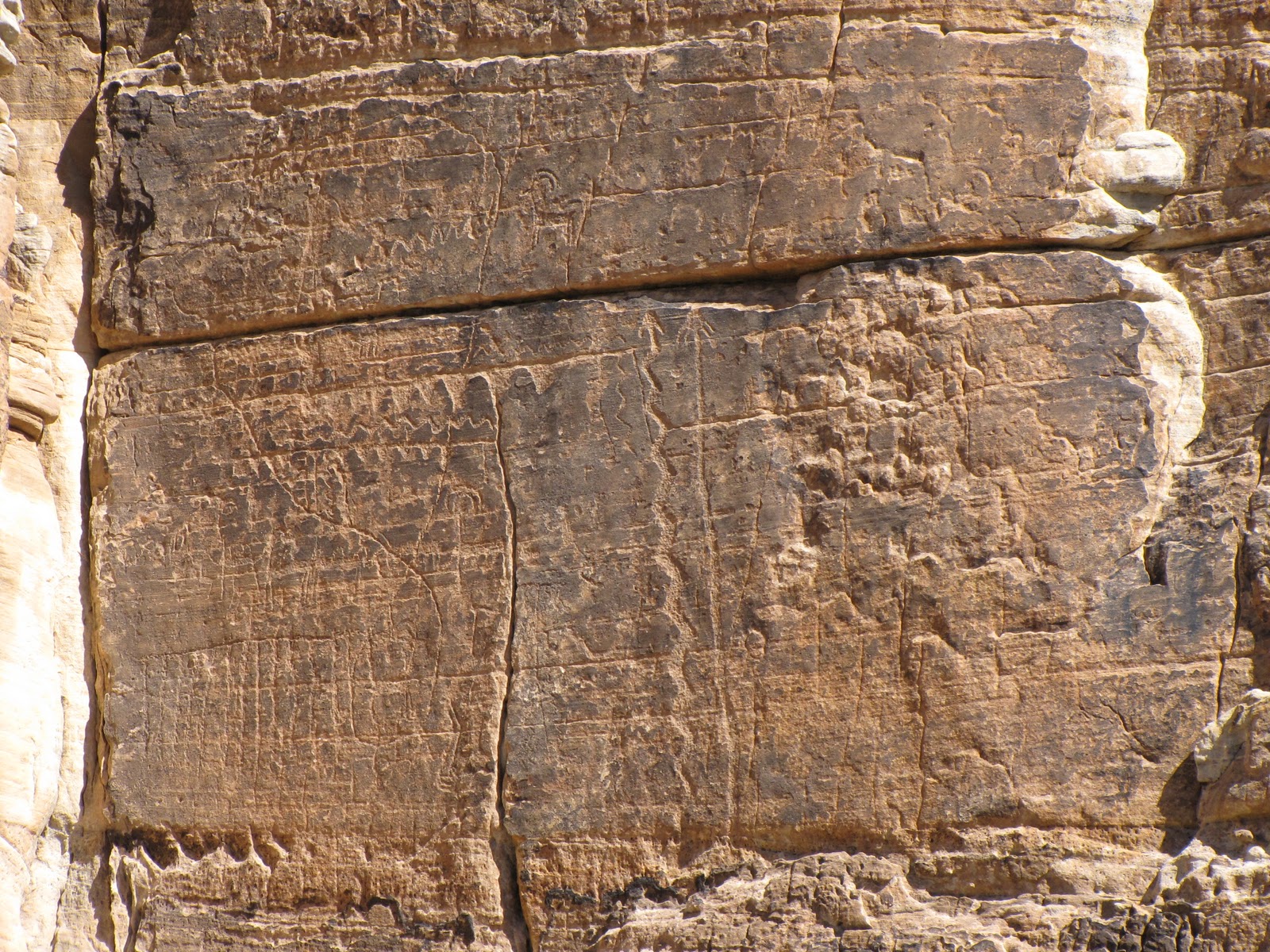
A very good place to see a valley full of petroglyphs, Chevelon Canyon, is on a private ranch just west of Holbrook and close to Winslow, AZ. It was mentioned in our Frommer’s guide to the American Southwest. It is part of the old Hashknife Ranch which was the largest ranch in the US in the late 1800s. You have to make a reservation and pay a fee to see the canyon, (928) 288-3260 available Monday through Saturday year round. We were debating this after our wonderful day in Petrified Forest National Park.

Incidentally, we met a couple at dinner that evening, Deb and Don, who had made a reservation to visit the Rock Art Ranch and invited us to join them. We met up with them at the Holbrook Safeway, where we picked up our lunch, and drove to the ranch, about 30 minutes southwest of Holbrook.

At the ranch we were met by Brantley Baird, the 75 year old owner and guide, if he isn’t out on his horse tending the cattle and bison herd with his ranch hand, the “old cowboy” (90 years old this month). He is a quiet-spoken gentleman with many years’ worth of stories of life in the Arizona ranch land. None of his sons is interested in living there and carrying on the ranching
or petroglyph preservation. First on his agenda is a look at the ranch’s history displayed around the sides of a large mess hall. But, for us, the best was the display of MANY museum quality ancestral Puebloan pots of all kinds, arrowheads, tools, and other household and hunting items, many of which he had found over the years on the property.


After the tour of ranch buildings, we were taken to see the bison herd and stopped at a Hopi Hogan on the short drive to the petroglyphs. At the Chevelon Canyon site there is an overlook with several roof covered picnic tables to get out of the sun for lunch. The stone stairs down to the canyon floor follow the same route used by the Ancestral Puebloans to access this water source from their mesa top houses and fields.
The thousands of petroglyphs are viewable from the stream bed at your leisure. It was a hot sunny day and we were melting until we offed our shoes and socks and soaked our feet in the cool, fast-running water of the stream. The only requirement is to lock the gate when leaving and drop the key into the lockbox on the gatepost. The four of us wandered around a short segment of the canyon, exclaiming over the extensive petroglyphs and marveling that they had remained intact with virtually no graffiti over many centuries.


This is a great site to view petroglyphs up close and at your leisure. Take water and a lunch and have a full day to spend at the Rock Art Ranch. If you plan ahead you could arrange to tent at the site and have lots of time to view the petroglyphs. Go soon, because who knows what will happen to this fascinating site when Brantley Baird is no longer in charge.

Wednesday, October 6, 2010

Painted Desert (Part 2 of the Petrified Forest and Painted Desert NP)

Monday, Sept. 27


(Post 2) This whole area is part of the Painted Desert, but the exposures of the Late Jurassic Chinle Formation in the northern half of the national park are spectacular. Seeing this formation in low angle sunlight makes the rock colors brighter. This particular formation features two odd rock shades: one is a lovely sage green through grey, and the other is a dark aubergine. Very odd, very dramatic. The colors were vibrant and changing as clouds past overhead. In the park it is fun to see the petrified wood logs acting as the caprock for some of the exposures. The petrified pieces range through every shade of brown to red, gold, orange and white.


We knew we wouldn’t want to drive back to Flagstaff after a day of driving, hiking, and taki
ng pictures in the sun, so we stayed in Holbrook, close to the park entrance, for the evening. At dinner we met a couple from Carlisle, PA. and accompanied them the next day to the Rock Art Ranch outside of Holbrook. (see next posting on petroglyphs and Ancestral Puebloan artifacts.)


Tuesday, October 5, 2010

Sedona Arizona

Hi everyone,


We are in Sedona, AZ for the next 2 weeks. Luck for us the weather has broken and it is not 100 any more. But, there is a low pressure hanging around and there are spectacular thunderheads with associated thunder and lightening and today impressive rain...... We are expecting Travis and Bill on Friday after their Grand Canyon hiking extravaganza. They have requested some pool time while here so hopefully the weather will cooperate. We are having some hail now and Alison has ran outside for some samples.  Earlier Alison got a video of the rain.  "It's raining like stink."

Oh well....we had our camping grill to cook dinner so all's well.  We could stay in and avoid the mess on the roads.


Petrified Forest National Park


Monday, Sept. 27


Today we drove about 90 miles east of Flagstaff to the Petrified Forest and Painted Desert National Park. The visit was FABULOUS!!! The guide books said take a half day to see the park so we planned ahead to have a full day there. We started at the south entrance about 9 AM, where most of the large accumulations of petrified wood are located, and progressed northward to see the best viewings of the Painted Desert in the late afternoon sun. (Seperate posting.)

The amount and color variations of the petrified wood were impressive. The landscape was literally littered with pieces of petrified wood from small fragments to pieces of trunk up to 100 feet long and 4 or 5 feet in diameter. We were good law abiding citizens and didn’t take any pieces with us. (This was VERY hard. On the way into the park we had to have the ranger mark all the rock pieces we had already collected along the trip so we wouldn’t be fined for these.)


Reminds me of a fallen column in Greece.

The ability of the petrifying process to create very life-like looking mineral replacements of the wood cells repeatedly caused us to try to scratch the wood surface to check if it really was not soft wood. It was always rock. The bark looked like bark, the broken off limb holes looked real, even the weathering process made the petrified logs look rotten! In some places, the petrified wood had broken into tiny wood “chips”, just as though someone had walked away from chopping firewood.

We found our next house, the Agate house, but have to negotiate with the Federal Government to relocate it to a more suitable climate. It probably weights a million pounds so I’m sure the move could be costly.
Our Agate House

Is this rotten?

Ancestral Puebloan Ruins

   
Aztec Ruins National Monument, New Mexico
We are spending a number of days looking at various Ancestral Puebloan sites in the 4 Corners area where Utah, Colorado, New Mexico, and Arizona meet. This post will talk mostly about the architecture.
Salmon Ruins, New Mexico
Restored Great Kiva at Aztec Ruins site
The time frame of these ruins is from 1100 to 1300 AD. The Ancestral Puebloans were first active in the 4 Corners area as hunter-gatherers from about 900 AD onward. Once planting maze, beans, and squash was learned they started building more robust structures and by 1100 AD were establishing the communal and spiritual habits that allowed and required the larger multifamily sites. These communities grew in size with the largest being built and occupied about 1250 to 1280. But, by 1300, all the sites were abandoned and never reoccupied. Why? Several differing opinions range from outside attack to extended area-wide drought.

Present day Navajo hogan roof similar to kiva roof.
The most familiar site is the cliff dwelling sites at Mesa Verde (see Sept 21 post). But since most Ancestral Puebloans lived on the mesa, estimated about 85%, most ruins are collections of rock walls with a few square rooms and one or more kivas, to large sites several stories tall with hundreds of rooms and 10s of kivas. The round kivas were the communal gathering places with a center fire pit for warmth.

This builder used a decorative mixture of large and small stones. 

The rock walls are impressive and usually one to two feet thick. Roofs and second story floors are wooden rafter supported with a yucca/twig/juniper bark layer topped with an adobe layer. Not a light weight roof, but very durable and insulating. The picture of a modern day Hogan ceiling shows how this roof construction is still used today.


Second and third occupations are visible in the room alterations, additions and wall builder variations. Some are very detailed builders while others look like they needed a quick addition for an unsuspected family addition (pre birth control days).


Ceiling height of 1st floor is to the round joist holes.
The rooms had low ceilings and the building traditions are taught and carried on even to present day. A handy skill to list on your National Parks job application!


Restoration at the Aztec Ruins.

Round kiva retrofitted into a square room.

Lizard eating moth


Another noted change in the 4 Corners area is in the wildlife sightings. The bear, elk, deer, and mountain sheep of Alberta, Montana and Wyoming have been replaced by lizards, snakes, bison, toads and insects.

Misc. snake at Rock Art Ranch (We were seen before we saw.)


Bison looking for a handout at Rock Art Ranch

Collared lizard at Pertified Forest
 

You can't see me.  I'm a rock lichen.